Phileas Fogg's status as a suspected bank robber
Around the World in Eighty DaysPhileas Fogg's status as a suspected bank robber is a false identity imposed on his journey by Fix, whose circumstantial case turns Fogg’s genuine wager into an apparent criminal alibi. A telegram identifying Fogg as the thief transforms him from a reserved traveller into a wanted man; from then on, the possibility of arrest shadows his passage through the British-controlled ports and threatens to delay the voyage on which his wager depends.
The suspicion takes shape
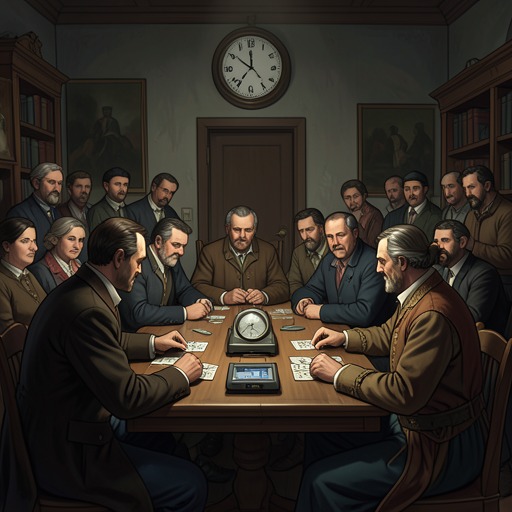
The suspicion begins with a message sent from Suez to London. At nine one evening, the commissioner of police receives Fix’s telegram identifying Fogg as the bank robber and requesting that an arrest warrant be sent to Bombay. Its effect is immediate. At the Reform Club, where Fogg’s photograph hangs among those of the other members, observers scrutinize his features against the description supplied to the police. His solitude, abrupt departure from London, and mysterious habits are recast as signs of guilt. The wager, previously the public explanation for his trip, now appears to the police and the Club members to be a pretext for escaping detection.
The accusation draws force from facts that are real but ambiguous. Fogg has departed quickly, carries a large sum, and is travelling to distant countries; he has also begun service with Passepartout only on the day they left London. When Fix questions the servant, he learns that Passepartout knows little about his master: Fogg lived alone in London, was believed to be rich, and kept the source of his wealth and the details of his affairs obscure. Fix treats this ignorance as confirmation. The evidence tells him that Fogg is difficult to know; Fix concludes that he must be a fugitive.
A wager mistaken for a disguise
The criminal theory depends on treating Fogg’s wager as a cover story, but the terms of the wager make that interpretation strikingly unstable. At the Reform Club, Fogg accepts the possibility of delays from bad weather, contrary winds, shipwrecks, railway accidents, and other mishaps as part of the challenge. When opponents argue that the journey’s eighty days represent only the shortest possible time, he maintains that a well-used minimum is sufficient. He stakes £20,000 held at Barings Bank, a concrete commitment made in front of the Club rather than a private excuse invented after the fact.
Fix nevertheless tells Passepartout that the wager is merely a pretext and that the Club members have been deceived. He produces a document describing a robbery of £55,000 from the Bank of England on 28 September, then claims that the description of the robber exactly matches Fogg. Passepartout rejects the accusation, insisting on his master’s honour, but Fix counters that the servant scarcely knows him. That response exposes the weakness in Fix’s reasoning as well as its strength: Passepartout cannot offer a detailed account of Fogg’s past, yet Fix’s suspicion likewise rests on an interpretation of concealment, not on direct evidence of the robbery.
Fogg’s own language about uncertainty adds a pointed contradiction. When challenged to account for mishaps, he says that the unforeseen does not exist; in practice, however, the journey is vulnerable to events he cannot command. Fix’s accusation is one such unforeseen burden. The carefully calculated wager does not become fraudulent merely because the police reinterpret it, but the police’s suspicion makes the wager harder to complete by threatening the traveller with detention.
The pursuit across ports
Fix’s pursuit is governed by the changing reach of the law. He boards the Rangoon at Calcutta without Passepartout seeing him and arranges for any arriving warrant to be forwarded to Hong Kong. The brief stop at Singapore offers too little time to act. Hong Kong, in Fix’s view, is the last English ground Fogg will visit; beyond it lie China, Japan, and America. A warrant could allow Fix to arrest Fogg there and hand him to the local police, whereas beyond Hong Kong he believes an extradition warrant would be necessary, with delays that might let the suspect escape.
The warrant has not yet arrived, leaving Fix to consider how to prevent Fogg from sailing onward if the opportunity comes. After failing at Bombay and Calcutta, he sees Hong Kong as the point where the pursuit must succeed. His effort to renew his acquaintance with Passepartout is therefore tactical: the servant may help him keep Fogg within reach, but Fix must first conceal his purpose. When he finally decides to make a clean breast of matters, he reveals that he is not an agent of the Reform Club and presents the bank-robbery accusation directly to Passepartout.
Consequences for the journey
The suspicion changes the meaning of Fogg’s progress without changing the stated object of his wager. Each port becomes a possible site of arrest, and the timing of the warrant matters alongside the ships and trains. Fix’s need to detain Fogg arises not from proof presented in these episodes but from his conviction that the traveller will otherwise escape beyond the warrant’s reach. The pursuit thus converts a private wager into a contest over mobility: Fogg must keep moving to meet his deadline, while Fix needs to stop him long enough for the law to catch up.
The danger remains present even as Fogg crosses the Atlantic aboard the Henrietta. The voyage may cover the three thousand miles from New York to Liverpool in the nine days between 12 and 21 December, provided the sea, wind, and machinery cooperate. Yet the prospect of arrival carries another risk: the affair aboard the Henrietta, together with the Bank of England accusation, may create new difficulties for Fogg. The suspicion therefore follows him beyond the immediate reach of Fix’s planned arrest. It is not merely a mistaken label attached to his reputation; it is a source of legal and practical uncertainty capable of disrupting the journey whose apparent improbability first made Fogg look suspicious.